

After over 30 years as head mistress, Annie Cross retired as headteacher in December 1932. However, her name appears a few more times in the log book as a manager. It seems fitting that she continued to oversee her life’s work. Edna Whaley became head in January 1933 but she was soon replaced by a temporary headteacher and Gladys Baker took on the headship in June 1934.
The 1930s began quietly. 3 new stoves were fitted and the outside lavatories rebuilt. The school was redecorated regularly but improvements in general remained insignificant. Early on, school milk was introduced. The number on the books gradually declined from between 68 at the start of the decade to 41 when, in 1937, the school saw a big change: “School reopened today after the Christmas vacation as a Junior Mixed and Infants’ School. It was reorganised, as of Jan 1st. The senior scholars have been transferred to the new senior school at Upper Stratton, opened this morning. There are now 26 children on the books, and there is no change in the staff.”
Gladys Baker was unwell in 1938 and a supply teacher was employed. Upon her return, she records “I much regret to report that on my return I have found things in a state of unbelievable disorder. The children have been allowed to get completely out of control and have damaged property both inside and outside the building. The work of the children has in most cases deteriorated considerably.”
Things were rapidly put back in order because a report shortly after by His Majesty’s Inspector concludes “The children are happy and well-behaved, they are interested in their lessons and show initiative and self-reliance…” Numbers were very low at 21 by this time, which was causing concern, but that was soon to change.
The following are the log book extracts from the start of World War II:
1 Sep 1939
“When school assembled this morning, the children were dismissed until further notice. This was in accordance with instructions received from Headquarters, owing to the country being in a state of National Emergency.”
13 Sep 1939
“School reopened this morning. During the closure 44 children from Barking, Essex have been billeted in the village. These children have been evacuated owing to War having been declared with Germany. The Village Hall is at present being used as a school for these evacuees, who with three teachers commenced work there this morning.”
26 Sep 1939
“Mr CC Parmee (HMI) and Mr HH Waterman (Director’s assistant) visited the school and the Village Hall to confer with teachers as to the best method of reorganising the two groups of children.”
3 Oct 1939
Mr Parmee and Mr Waterman again visited the school with suggestions for the re-organisation, which will be carried out at the beginning of the coming week.
9 Oct 1939
“The working of the school was re-organised as from this morning. The evacuees have been absorbed and the whole redivided into two groups, according to age. The younger group (7, 8, some 9 year-olds) are being taught in the Village Hall by Miss Wood, a Barking teacher. Only five S. Marston children have been removed. The rest, (some 9, the 10 and 11 year-olds) are in the school, being taught by the Head Teacher.”
There followed numerous changes in the number of evacuees and the organisation of teaching over the next few years. The school day was amended to account for the continuation of British Summer Time throughout winter and school closed each October for the harvesting of potatoes. A programme of diptheria immunisations began in 1941, this being the first vaccine of the bacteriological age to be offered free to British children on a national scale. A hot dinner scheme was put in place in 1944, with meals being sent over from Wootton Bassett, but it was often beset with transportation problems.
Finally, on 8 – 9 May 1945, “Victory in Europe Days. School closed following cessation of hostilities”.
Strangely, there was no mention of the evacuees returning home at any point in the log book, only the return of desks and chairs that had been on loan from Northbury School, Barking.
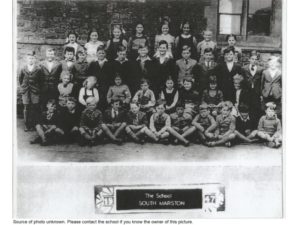 Late in the decade, intelligence tests for 7, 9 and 10 year-olds, arranged by Swindon Education Authority were launched, followed by the school becoming recognised as having Controlled Status by the Board of Education in 1951.
It wasn’t until around this time that running water was installed. Soon after, the lavatories were connected to the main water supply and a teachers’ lavatory was provided in 1953. Past pupils may recall the partition in the main room (now the hall) creating two classrooms. It was fitted in 1955 due to a shortage of space and remained in place for many years. Two Alycan stoves were installed to heat the new spaces.
Report by HMI in 1956:
“…There are three small classrooms, two divided by a movable partition. The older children, 21 in number, are taught by the Head Mistress. The 7-8 group, 25 in all, have had many changes of teacher over the past 4 years, and are at present taught by their third teacher since September 1955. The Infants, 21 in all, are taught by a mistress, who like the Head Mistress, has given long and devoted service to the school…”
“There is a close link between school and village. It is unfortunate there is no adequate space for folk dancing.”
Folk and country dancing appears to have been quite an important activity from this time forward, becoming regularly noted in the log book and with festivals taking place in Swindon annually.
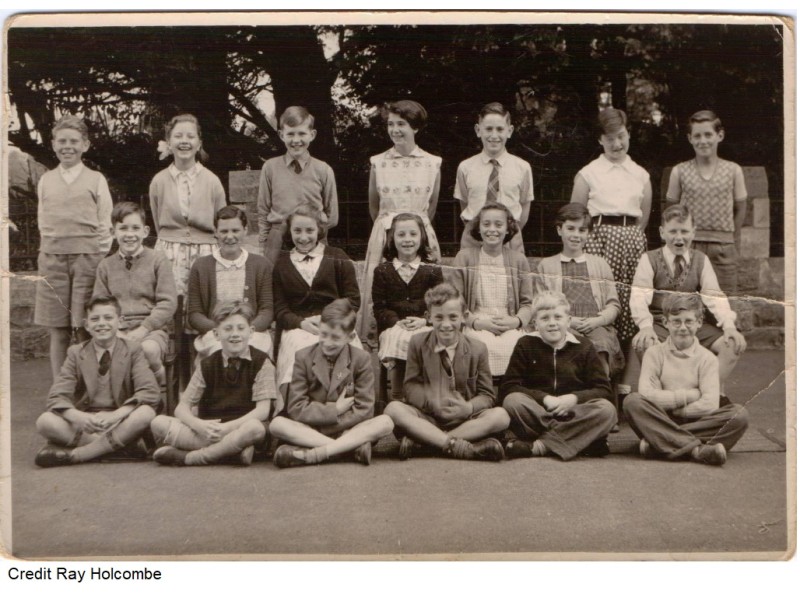 Gladys Baker resigned in 1960, after 26 years of service to South Marston School. It is sad that no photographs of her appear to be in existence.