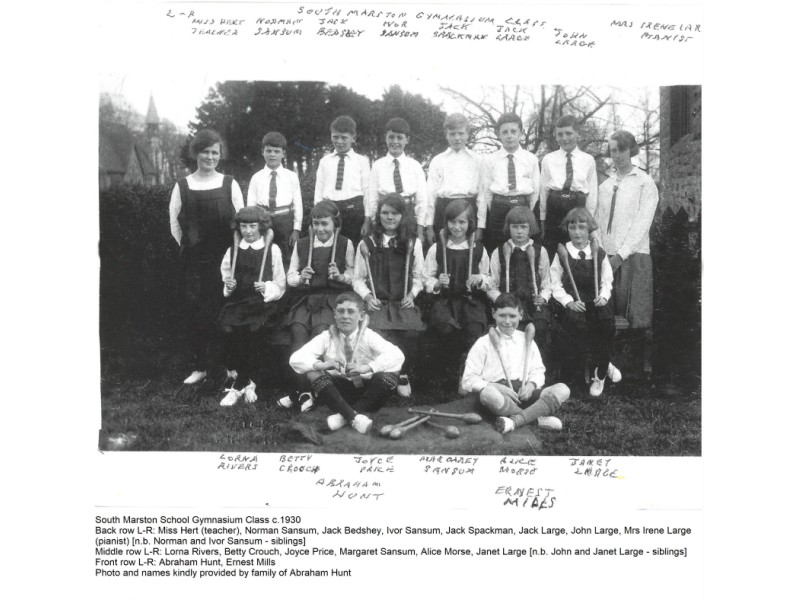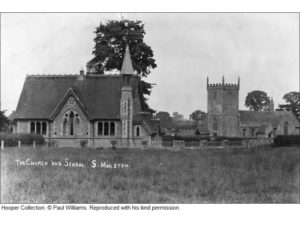
School 1905. Copyright Paul Williams
Alfred Bell became ‘Lord of the Manor’ in the mid-1800s and the family paid for a number of village improvements, including renovation of the church and the building of the schoolhouse. And so South Marston School opened to the children of the village and surrounding farms in June 1873.
A long article was published in the North Wilts Herald on Saturday 28 June 1873 and may be found on the British Newspaper Archive website. The piece gives extensive particulars of the building, inside and out, and provides details of the celebrations.
Three days of festivities began on Wednesday 25th June 1873 with a luncheon at Mr Bell’s residence for local clergy and other dignitaries. After luncheon, the party proceeded to the church, where there were numerous speeches to a large congregation. All comers were then received onto the lawns for tea at the Manor.
The following day, a treat was given to the children attending the Day and Sunday schools, and on Friday the parents of the children were entertained.
The Swindon Advertiser ran an article about the Friday tea for parents of the children reporting that “65 sat down to a capital tea, provided for them in the school room. The tables were well supplied with tea, bread-and-butter, pots of jam, marmalade, potted meats, chicken and tongue &c &c, which seemed to be most heartily enjoyed. After tea, all retired to the adjoining field, whilst the room was arranged for the evening’s entertainment, and witnessed a balloon ascent.” The evening’s entertainment consisted of a musical programme, speeches and readings.
Most people will know the name of Alfred Williams (1877-1930), “The Hammerman Poet”, who was born in South Marston and lived here most of his life. His writings include references to South Marston School, where he attended full time until the age of eight and then as a “half-timer” until the age of eleven. His schooling took place at a time when education was not free, so money had to be found each week to send children to school. Miss Deacon, the school mistress, provided a simple and limited education.
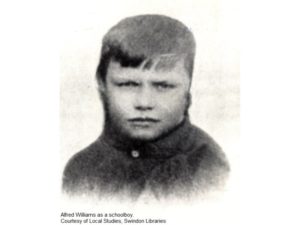
Alfred Williams as a schoolboy. Courtesy of Local Studies, Swindon Libraries
The first school log book we have is from 1903, and is stored in the Wiltshire Archives; no previous log book has been found (although the disappearance of a log book was mentioned in the Managers’ Minute Book in 1900). By this time, Annie Cross was the headmistress, and she was to remain in position until 1932. She was assisted by two supplementary staff. Between them, they taught the 77 children on roll.
Many of the supplementary/untrained teachers changed regularly, as did the number of children on roll. There were 97 children attending in 1910 when a Diocesan inspector noted “I have again nothing but praise for this charming little school. The brightness and cheerfulness of the children and the feeling of affection between them and their teachers were most marked…”
The log book was very scant in detail in those days but the regular weekly scripture classes by the vicar were always recorded and there were many references to the health of the children. Attendance was sometimes severely depleted owing to outbreaks of influenza, whooping cough, chickenpox and other childhood diseases. Some entries record children with “dirty heads” and parents summoned for “neglect of their children. They are at school today very dirty and badly shod”. Two poor children were examined by a doctor to “ascertain reason of mental deficiency” and a dentist called from time to time to check the children’s teeth and to extract them when necessary.
This was clearly a school in a rural community. Each spring, gardening instruction commenced for the boys on the school plot. There were periods when lads were employed by farmers for harvesting and general labour, and the summer break was taken from June until August, probably to fit with the busiest months on local farms.
The log book records times when “many scholars have left and new ones been admitted owing to change in labourers by the farmers”. Alfred Williams became a half-timer, no doubt like many others, to work for a local farmer. The log book also reports parts of the village and fields flooding from time to time, affecting attendance.
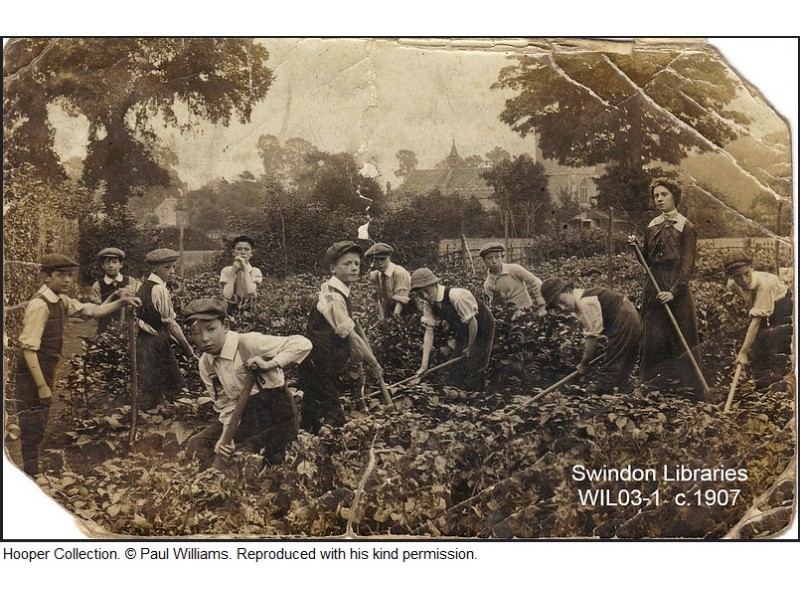
Copyright Paul Williams
It is strange that the 1914-1918 war did not feature at all in the school log book until it was first alluded to in November 1917, when 4½ bushels of acorns (about the yield of half a large tree) were gathered by the children and sent to the munition works. In December 1917, 4½ cwt of chestnuts (approximately 225 kg) were sent to the munition works. The pressures of war became more evident when, in March 1918, the vicar visited to discuss the rationing of coal to the school. Later the same year, the children were employed in regular blackberry picking with the fruit going to the Central Agency. Sadly, the log book notes that many students were absent due to influenza in October 1918, when the school was closed for a month by order of Dr Crossley. Cases continued to be recorded until February 1919. There were 65 children on roll in December 1918 and an inspection five months later noted that the head teacher had been without teaching help for the 49 older scholars since then.
The school continued much as before in the 1920s and 1930s. The school building remained unchanged, except for occasional redecoration. And the children’s learning continued as usual, with a few special events added to the records – one outing in 1924 when fifteen of the oldest scholars were taken to Wembley for the British Empire Exhibition, a whole-school trip to Weston-Super-Mare in 1930, and the advent of area sports competitions.