

South Marston School has been open for over 150 years. But did you know that a village school was in existence even before that date?
In the early 1850s, Miss Rowden of Highworth, daughter of the then vicar Rev Edward Rowden was concerned that the children of South Marston village received little education other than at a small dame’s school, so she raised subscriptions and was able to build a small school by the roadside near the site of our current school. It was considered a valuable asset and was subsequently enlarged by Mr Alfred Bell, Lord of the Manor. But by the early 1870s, it was found to be entirely inadequate for requirements and so Mr Bell set about funding and building a more substantial school. His main aim was that religious education should be taught, together with a rudimentary education and instruction in home and domestic skills for the girls.
The new school was opened in 1873 and the North Wilts Herald article covering the opening went into great detail of all aspects of the structure, which fortunately remain in place today. It’s an example of early English Gothic architecture. The walls are built of local stone faced with Swindon stone. Doors, windows, the bell tower and turret are dressed with Bath stone. The original school consisted of two rooms – the schoolroom and a smaller classroom, separate entrances for boys and girls with cap and bonnet rooms attached, and was designed for 120 children, of which 90 were expected to attend at any one time.
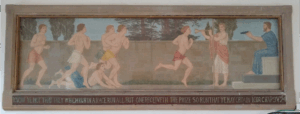
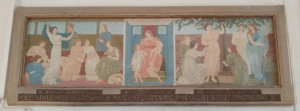
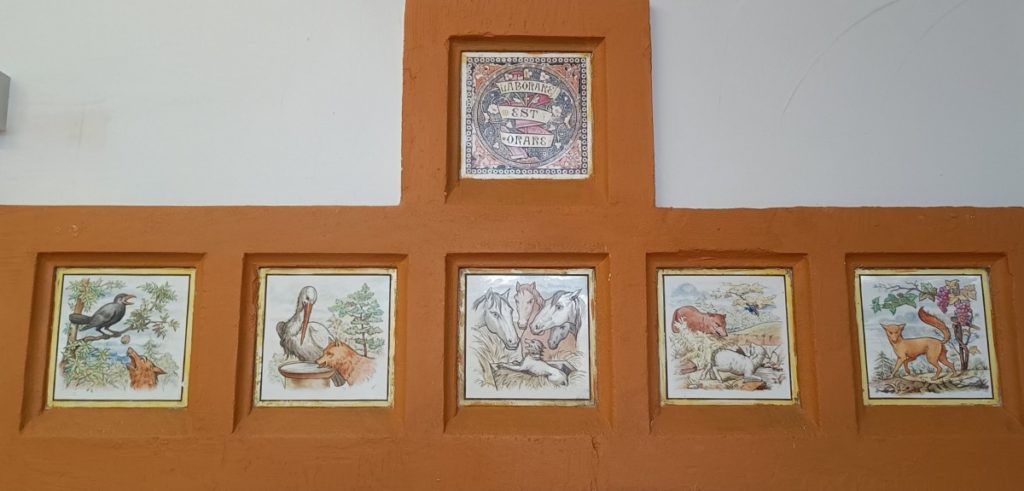 All those who have passed through the school will have seen the painted tiles on the chimney-piece illustrating some of Aesop’s fables by Gibbs and Moore of London, and the paintings either end of the room, painted by a well-known artist, Henry Holiday of London, a member of the Pre-Raphaelite circle. The one at the boys’ end shows runners in a Greek stadium and depicts a passage in the Corinthians, emphasising the need for focused effort and perseverance in pursuing a goal, particularly a spiritual one. The painting at the girls’ end is divided into sections and illustrates morals from the Book of Proverbs.
Alfred Bell spared no expense with funding the school. In addition to the beautiful artwork, there were ample playgrounds with flowerbeds in view for the children to enjoy. Boys and girls played separately, with a swing in the girls area and parallel, horizontal and jumping bars in the boys’ playground. The classrooms were fitted with Colman and Glendennings Eastern Counties patented desks. They could be adjusted to flat for working or sloping for writing and drawing. Additionally, they could be converted into a backed seat or two placed together to form a table for tea-meetings. Desks were placed on a stepped platform and were moved to side walls when the room was in use for other activities. The stepped platform could also be adjusted to form an infants’ gallery. Very ingenious and versatile! Lighting was by coronae with candles for wintertime working and any evening entertainment taking place.
The opening of the school in June 1873 was attended by many dignitaries, and included Miss Rowden. She was honoured by Alfred Bell for her efforts to provide day and Sunday schools in the village and for taking education to where it had led that day. Two very philanthropic individuals for whom we have to thank for many years of good education in South Marston.
If you would like to read the full North Wilts Herald article dated 28 June 1873, it can be found on the British Newspaper Archive website.